INDUSTRY KNOWLEDGE CENTER
John's Corner
Practical tips, industry insights, and real-world strategies to help snow professionals work more efficiently, reduce costs, and deliver better results.
FROM THE FOUNDER
John Parker
Founder & Industry Pioneer — Taconic Maintenance
For more than three decades, John Parker has helped contractors improve winter operations through innovation, education, and proven field experience. This page shares practical tips, industry insights, and real-world strategies to help snow professionals work more efficiently, reduce costs, and deliver better results.
FEATURED ARTICLE
Anti-Icing vs. Deicing: Understanding the Difference
One of the most important distinctions in professional snow and ice management is the difference between anti-icing and deicing. Understanding when and how to use each approach is the foundation of an efficient, cost-effective winter maintenance operation.
What Is Anti-Icing?
Anti-icing is a proactive strategy. It involves applying a liquid deicer to pavement surfaces before a winter weather event begins — typically 30 minutes to several hours before precipitation is expected. The goal is to prevent ice from bonding to the pavement surface in the first place.
When a liquid deicer like Ice B Gone Magic is applied before a storm, it creates a thin chemical barrier between the pavement and incoming precipitation. Snow and ice cannot bond as strongly to a treated surface, which means removal requires significantly less product, less labor, and less time.
What Is Deicing?
Deicing is a reactive strategy. It involves applying product after ice or snow has already bonded to the pavement. This is the approach most contractors default to — and it is consistently the more expensive, more labor-intensive option.
Deicing requires breaking an existing bond between ice and pavement. That takes more product, more passes, and more time. In heavy accumulation events, deicing alone can become a losing battle — especially when temperatures drop and product effectiveness decreases.
Why Anti-Icing Wins on Cost
The economics of anti-icing are straightforward. A pre-treatment application of IBG Magic at the correct rate prevents bonding. A reactive deicing application after the fact requires significantly more product to achieve the same result — often two to three times as much.
Over the course of a season, contractors who incorporate anti-icing into their protocols consistently report lower material costs, faster service times, and higher client satisfaction. The upfront investment in a liquid application system pays for itself quickly.
When to Use Each Approach
Anti-icing is most effective when applied before light to moderate precipitation events where pavement temperatures are at or below freezing. It is particularly valuable on high-traffic surfaces, bridges, and areas where ice formation creates liability exposure.
Deicing remains necessary in heavy accumulation events, when anti-icing was not applied in time, or when conditions change faster than anticipated. A professional operation uses both — anti-icing as the primary strategy and deicing as the backup.
KEY PRINCIPLE
Anti-icing prevents the bond. Deicing breaks it. Prevention is always more efficient than remediation — in winter maintenance and everywhere else.
FIELD INSIGHT
Contractors who switch to an anti-icing-first protocol typically reduce material usage by 35–50% per season. That reduction goes directly to the bottom line.
Application Guide
The 2 Out of 3 Rule: When Should You Apply Ice B Gone Magic?
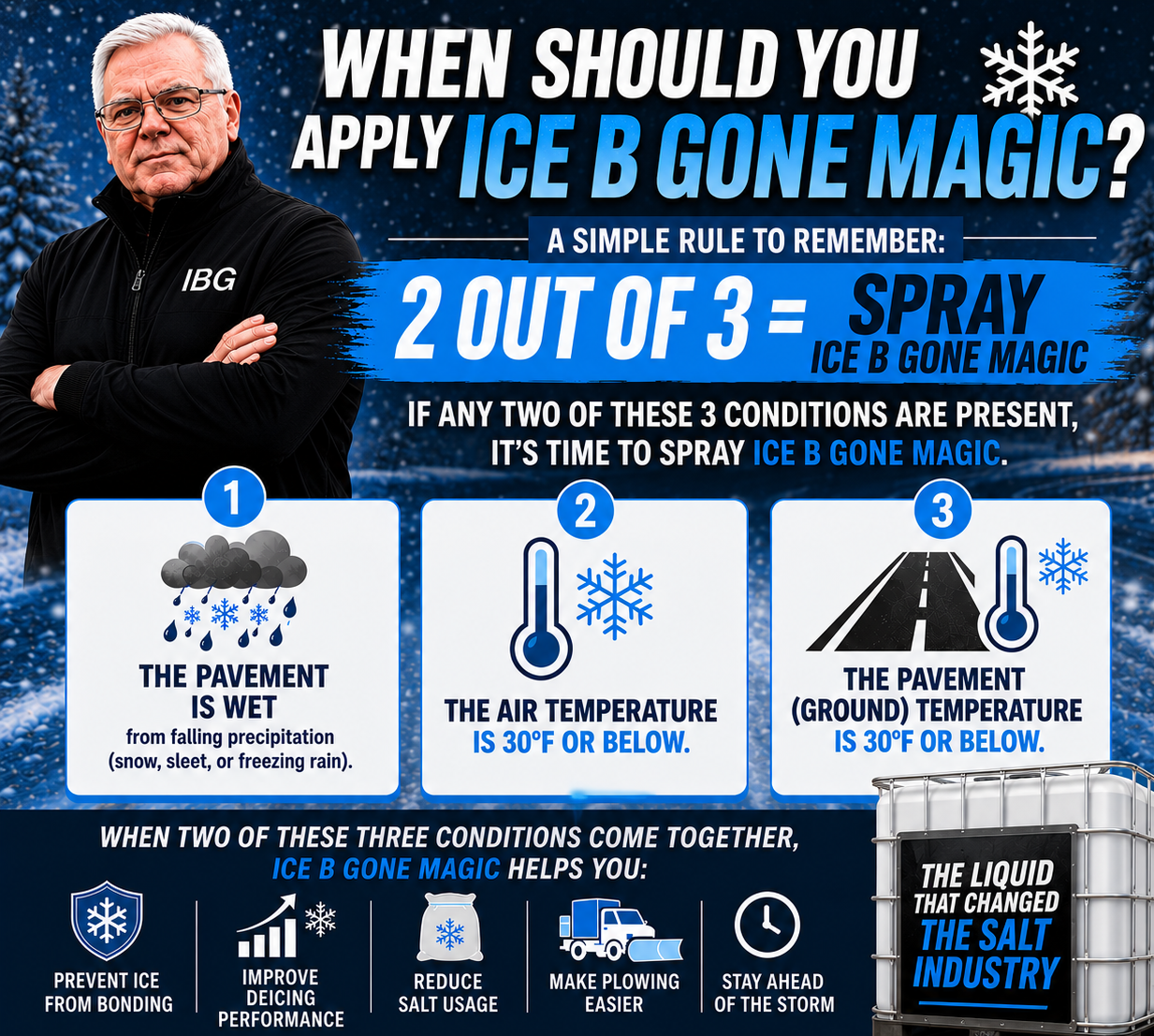
Knowing when to spray is just as important as knowing how. After 30 years in the field, John Parker developed a simple decision rule that takes the guesswork out of application timing — the 2 Out of 3 Rule.
The Three Conditions
Ice B Gone Magic works best when applied proactively — before ice bonds to the pavement. The 2 Out of 3 Rule gives you a clear, field-tested trigger: if any two of these three conditions are present, it's time to spray.
The pavement is wet
From falling precipitation — snow, sleet, or freezing rain.
The air temperature is 30°F or below
Cold air accelerates ice bonding on treated surfaces.
The pavement (ground) temperature is 30°F or below
Ground temperature is slower to cool than air temperature — don't overlook it.
Why Two Out of Three?
A single condition alone rarely creates the perfect storm for ice bonding. But when two converge, the risk spikes dramatically. This rule prevents over-application on dry cold days while ensuring you never miss a genuine icing event.
When two of these three conditions come together, Ice B Gone Magic helps you prevent ice from bonding, improve deicing performance, reduce salt usage, make plowing easier, and stay ahead of the storm.
Pro Tip
Check pavement temperature separately from air temperature — ground temps can lag hours behind air temps during a warm-to-cold transition.
Key Benefit
Applying before ice bonds means you use 35–50% less product and dramatically reduce cleanup time after the storm.
Remember
2 out of 3 = Spray. Don't wait for all three conditions — by then, ice has already bonded.
COMING SOON
More Winter Wisdom Coming Soon
Future topics will include pre-wetting salt, liquid application strategies, reducing salt usage, equipment best practices, common contractor mistakes, and new innovations in the snow and ice industry.
AUTHORIZED DEALER PROGRAM
Apply This Knowledge With the Right Products
The principles on this page are built into every product Taconic Maintenance produces. If you're a contractor who operates at this level, we'd like to talk about an authorized dealer arrangement.
BECOME AN AUTHORIZED DEALER